



Key Takeaways
- The startup myth is loud, but the math is quiet: most new ventures fail, while most long-running small businesses survive.
- A massive wave of retiring founders is creating the biggest business-acquisition opportunity of the decade.
- Buying a profitable, steady business often requires far less upfront cash than people assume.
- Creative deal structures—seller financing, earnouts, partner capital—make ownership accessible, not elite.
- Acquiring a business gives you customers, cash flow, and a working model from day one.
- The smartest founders aren’t always inventors; some are strategic owners who step into systems that already work.
- If you want freedom more than fame, acquisition entrepreneurship is one of the most underrated paths available right now.
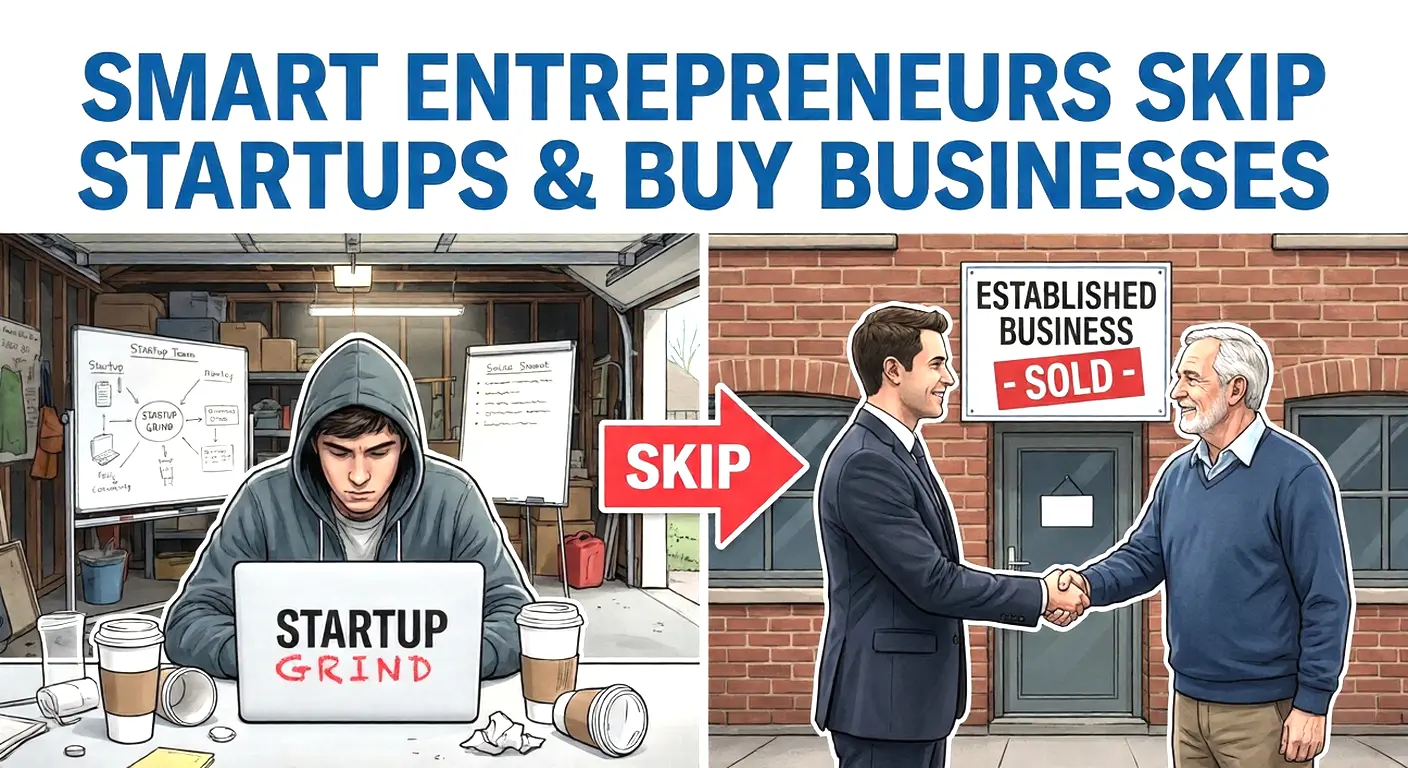
Smart Entrepreneurs Skip Startups and Buy Businesses
Somewhere between your first pitch deck and your fifteenth caffeine-induced existential crisis, there’s a moment every founder eventually hits: Does it really have to be this hard?
A decade ago, I believed it did. I romanticized those “build it from nothing” stories—garage desks, ramen budgets, the whole heroic founder mythology. The world says invention is the path. Real entrepreneurs bleed for ideas.
Then I met a man who didn’t.
He was a retired dentist who bought a sheet-metal company even though he couldn’t tell you the difference between a milling machine and a muffin tin. Ten percent down. Seller financed the rest. Within a year, he made more than in twenty-five years of staring into open mouths.
That moment cracked something open.
Entrepreneurship wasn’t just about creating.
Ownership—quiet, steady, unfussy ownership—was its own frontier.
“Some founders chase invention. The strategic ones buy momentum.”
The Business Marketplace Nobody Likes to Talk About
Every day, a wave of older business owners reaches retirement age. Many built the firms that actually keep the world turning—machine shops, clinics, HVAC companies, distribution outfits, agencies, small manufacturers. They aren’t on magazine covers, but they’ve been profitable for decades.
Here’s the tectonic shift underneath our feet:
- 90% of startups flame out.
- Most owner-run, profitable small businesses survive past five years.
- Millions of these businesses will need new owners this decade.
- Many sell for 2–4x annual earnings.
And here’s the kicker: the majority are too big for hobbyists, too small for private equity, too stable for VCs, and too “unsexy” for hype-driven internet discourse.
Which leaves an awkward little gap in the market…
perfect for the next generation of creative founders who want freedom, not fundraising.
Three Ways Regular People Buy Businesses
People hear “$2 million company” and assume they need to roll in with a Scrooge McDuck vault. But acquisitions are weirdly democratic—structured, flexible, and negotiable.
A few paths make ownership genuinely accessible.
1. The Bootstrap Buy
Your down payment isn’t supposed to be massive.
Think “nice car,” not “private island.”
The business’s own cash flow often pays for the loan.
Seller typically carries 20–50% as a note.
Banks fill in the rest.
This approach is so common now that many brokers treat seller financing as normal, not a distress signal.
2. The Partner Path
Some investors have outgrown chasing unicorns.
They want reliable cash flow, not pitch decks with NASA-grade optimism.
Family offices. Retired execs. Folks who had a big win and now want steady returns.
A buyer brings sweat.
A partner brings capital.
Everyone wins.
3. The Creative Deal
Think beyond cash.
One acquirer acquired a $3M HVAC business with no upfront cash.
How? He split profits with the owner for two years.
Once the transition was smooth, the founder handed over the reins.
Deals are puzzles. Not price tags.
Related : Influencer Growth Strategy 2026- Master Influencer Marketing
Why This Moment Matters
Four cultural and economic shifts are reshaping what “ownership” means today.
1. The Retirement Wave
The generation that built the backbone of modern small business is stepping down.
Many don’t have successors. Many don’t want to shut the doors.
They need someone to pass the torch to.
2. The Financing Shift
Bank attitudes have evolved.
SBA financing is accessible.
Seller financing is normal.
Mixed-structure deals are standard.
Capital is no longer the main barrier.
Creativity is.
3. The Remote Revolution
Technology dissolved geographic limits.
Founders now run factories from condo rooftops, manage teams across time zones, and redirect operations dashboards to their phones.
You don’t need to live where the business is rooted.
You just need to run it well.
4. The Startup Slowdown
VC funding isn’t the endless river it once was.
A business doing $2M in EBITDA is more attractive than a pre-revenue startup with a fantasy valuation.
While everyone fights over term sheets, thousands of profitable firms quietly wait for their next owner.
Thinking Like an Acquirer (Instead of a Builder)
Starting something from scratch gives you a creative rush.
Buying something gives you a head start.
An acquirer asks different questions.
Not “what problem can I solve?” but “what system already works?”
Look for industries with:
• recurring revenue
• fragmented players
• low capital demands
• steady, predictable cash flow
Pest control. Property management. HVAC. Distribution. Light manufacturing. Agencies with recurring retainers.
And aim for stable owners nearing transition—not struggling businesses begging for rescue.
In an acquisition, you’re buying proof.
A working model.
A customer base.
A track record.
Your job is improvement, not genesis.
A Local Lens: Why This Matters in Our Side of the World
Across our region, there are thousands of long-running, quietly profitable businesses built by first-generation owners—family firms, trade companies, service providers, niche manufacturers. Many founders are entering retirement without a succession plan.
They’d rather see their businesses continue than wind them down.
Local entrepreneurs often think their path must be digital: apps, platforms, innovation or bust.
But the most dependable profitability right now lives in boring, operational brickwork industries.
They don’t trend on social feeds, but they pay for homes, dreams and entire families’ futures.
While hype cycles move fast, fundamentals keep winning.
“What Could I Buy?” vs. “What Could I Build?”
Ask people at a startup meetup what they’re building, and they’ll tell you stories full of potential.
Ask an acquirer what they’re buying, and they’ll tell you stories full of revenue.
Builders bet on:
• an unproven idea
• customers they hope exist
• economics they modeled, not lived
• their willpower to go from zero
Buyers bet on:
• real systems
• real customers
• real financial history
• their ability to make something good even better
Both paths are noble. But one starts with momentum.
Buying isn’t simple. You’ll lose deals.
You’ll run diligence until your eyeballs buzz.
You’ll inherit teams who didn’t pick you as their leader.
You’ll feel the weight of responsibility in a way that “my startup is pre-product” never touches.
But you’ll step into something that already has:
• customers
• cash flow
• reputation
• rhythm
It’s a different kind of beginning.
Less romantic, more real.
The Path Forward
The best time to buy a business was a decade ago.
The second-best is right now.
There’s no moral virtue in building from scratch.
There’s no shame in skipping the suffering stage.
Ownership is ownership—whether you invent it or acquire it.
If you want freedom over fame, cash flow over chaos, autonomy over applause, then acquisition entrepreneurship is one of the most underrated paths in modern business.
The businesses exist.
The owners are ready.
The odds are friendlier than startup mythology implies.
Your only job is to step into the marketplace and start looking.
About The Author