



Table of Contents
- The Silent Shift: When AI Starts Thinking for You
- The Age of Digital Dependency
- The Science Behind Thinking Less
- Why the Brain Loves Shortcuts
- The Illusion of Intelligence
- When Help Turns into Handicap
- The Balance Between Assistance and Awareness
- The Future of Human Thought
- Final TheLucammmagz thoughts
1. The Silent Shift: When AI Starts Thinking for You
It begins with convenience. A quick ChatGPT search for clarity, a neatly worded summary, a rewritten paragraph that sounds a little smarter than what you wrote. Then, one day, the thought process behind it fades.
Steven Bartlett, in his latest talk, warns that the more we rely on ChatGPT, the less we engage our minds. Not because AI is evil — but because it’s easy. Science now echoes his caution: tools that think for us slowly train our brains not to think at all.
We are entering the age of cognitive outsourcing — and it’s quietly rewriting the human relationship with knowledge itself.
2. The Age of Digital Dependency
The 21st century’s greatest paradox is this: we’ve never had more access to intelligence, yet we’re thinking less.
A Harvard University Cognitive Science study in 2024 revealed that regular users of AI assistants experienced measurable declines in “spontaneous ideation,” the ability to form original thoughts. Similarly, Stanford’s Human-Centered AI Lab found that participants who frequently used text-based AI tools displayed reduced “metacognitive reflection” — the act of examining one’s own thoughts.
This is called cognitive offloading — when the brain starts delegating its labor to machines. We once offloaded memory (to phones), navigation (to GPS), and now reasoning (to AI).
3. The Science Behind Thinking Less
The human brain is wired to conserve energy. Deep thinking, creative problem-solving, or critical analysis are expensive processes — they demand glucose, focus, and emotional stamina.
Neuroscientist Dr. Ethan Kross describes this as “the cognitive energy economy.” When external aids promise faster results, the brain happily prunes old pathways. What’s not used, is lost.
In a study from the Journal of Experimental Psychology, participants who solved logic puzzles with AI support later performed 23% worse in independent reasoning tests. They also believed they’d done better — a double illusion: reduced performance, increased confidence.
AI doesn’t just simplify our thinking — it seduces us into thinking we’re smarter than we are.
4. Why the Brain Loves Shortcuts
Humans evolved for survival, not for contemplation. Efficiency feels like progress.
Every “quick fix” — from calculators to ChatGPT — activates reward centers in the brain, releasing dopamine, the chemical that makes efficiency feel good. Psychologists term this the satisfaction trap: the illusion that acquiring information equals understanding it.
When ChatGPT gives us the perfect answer, we feel the mental satisfaction of mastery without earning it. It’s like eating sugar instead of a meal — sweet, fast, and hollow.
Our ancestors sharpened their minds through curiosity, trial, and failure. We now flatten that process into a single prompt.
5. The Illusion of Intelligence
Steven Bartlett’s warning is not moral panic — it’s cognitive realism.
A University of Toronto study found that students who used AI-generated suggestions in essay writing scored higher in surface coherence but lower in originality and depth. As co-author Dr. Leah Sanderson explained: “They stopped wrestling with ideas. They learned to polish, not to probe.”
The digital world rewards polish. But real intelligence requires struggle — the uncomfortable friction of thinking beyond what’s convenient.
We’re not becoming less informed. We’re becoming less aware of how we form knowledge.
6. When Help Turns into Handicap
ChatGPT, like every tool, amplifies intent. It can empower — or enfeeble.
The muscle analogy fits perfectly: strength grows from resistance. Remove resistance, and strength fades. A 2025 Cognitive Science Research Network paper found that participants who used ChatGPT daily were “less likely to engage in slow, reflective reasoning” even without the AI’s presence.
Dependence becomes habit. And habits rewrite the brain.
This is where Bartlett’s concern resonates: not that AI steals intelligence, but that it discourages its exercise.
7. The Balance Between Assistance and Awareness
Rejecting AI isn’t the solution — using it consciously is.
When applied wisely, ChatGPT can extend cognition: helping summarize data, structure ideas, or test arguments. But it must remain a tool for thought, not a replacement for it.
Neuroeducators propose a few mental “guardrails”:
- Use AI for research, not resolution.
- Write or think first, ask AI second.
- Maintain analog spaces — journaling, walking, solitude — where raw thought breathes.
Even boredom, studies show, reactivates the default mode network, the brain region linked to creativity and self-reflection.
AI gives us information. Silence gives us insight.
8. The Future of Human Thought
The risk is not that AI will replace humans — but that it will replace human thinking.
In the next decade, the rarest skill won’t be data analysis or prompt engineering — it will be metacognition: the ability to think about thinking.
Those who can question their tools, not just use them, will define the next cultural and intellectual era.
Steven Bartlett’s message is simple but urgent: AI can’t feel wonder. It can’t doubt. It can’t long for meaning. That’s what makes us human.
If we surrender the act of thinking, we lose not knowledge, but consciousness itself.
9. Pull Quote
“AI can make us feel smarter while making us less so — that’s its most seductive danger.”
The allure of ChatGPT – speed, ease, convenience
Let’s not pretend the tool isn’t brilliant. Type a prompt, get a draft. Fix a few bits, publish. For someone under deadline, juggling multiple projects, the time-saving is seductive.
In a world where productivity is king, ChatGPT promises high output. It gives you language you might struggle to find, ideas you might not have had, rhythm you might envy.
But here’s the caveat: convenience often breeds complacency. When you start letting the tool form the ideas, the voice, the structure—what you gain in speed, you might lose in depth.
Steven Bartlett draws attention to the ease, but emphasises the hidden trade-off: you save time, yes, but you also skip the internal process that builds mental strength.
The hidden cost – when outsourcing thinking becomes atrophy
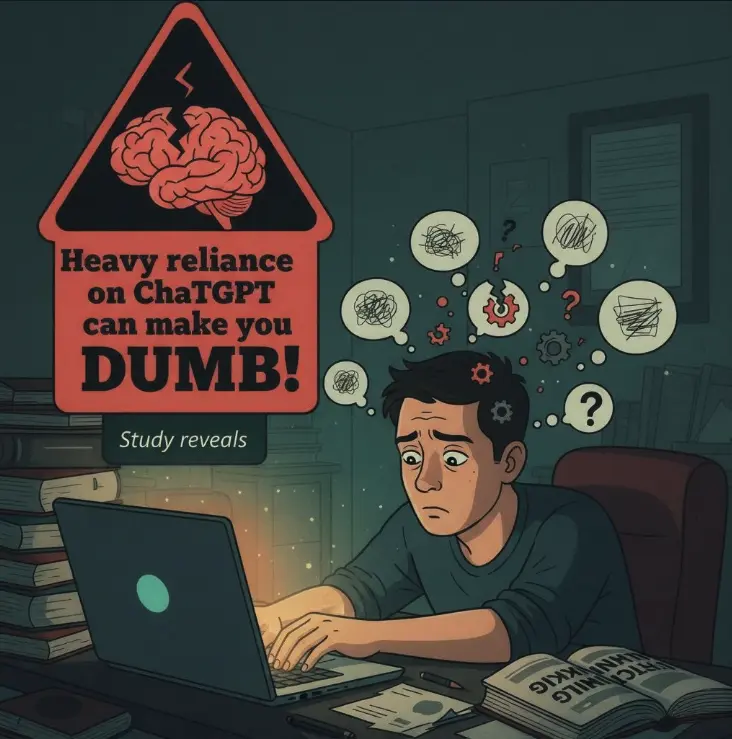
The brain is a muscle; effort builds it
Your brain doesn’t want to expend effort it doesn’t have to. Evolutionarily (nerdy note!), it conserves energy for things it expects will matter again. Bartlett uses this metaphor explicitly: if you don’t use your brain’s thinking muscle, it will atrophy. Tatler Asia
Let’s make this concrete: you ask ChatGPT to generate ideas. You refine. Great. Next time you ask it to generate again. And again. The prompt becomes routine. Your part shrinks. Over time you stop training your ideation, your critical reflection, your subtle judgement.
Then one day you realise: you’re faster, yes—but your insights feel flatter. Your memory of how you got there is foggy. Bartlett notes memory and recall suffer when we outsource thinking en masse. facebook.com+1
This isn’t alarmism. It’s a functional fact: mental pathways strengthen with use; they weaken with disuse.
Authentic output vs machine-polished output
Here’s where your craft meets the risk. Suppose you write a piece. You let ChatGPT improve grammar, fix structure, refine voice. The result looks slick. But did it still sound like you? Or did it start sounding like “AI-professional generic”?
Bartlett warns: if the tool improves grammar but erases your authenticity, you’ve lost the thesis of your value proposition.
Your voice, your unique thought, your internal struggle—these are the signature. If your work becomes indistinguishable from other polished pieces, you lose a competitive edge. Your creative identity becomes diluted.
And beyond identity: reflection, the subtle “why did I do that?” questions, the internal tension—all the places where meaning resides—get skipped. The machine polished the surface; you missed the depth.
Why you should care – for your craft, for your mind
If you’re reading this, you value creation. You value thought. You value being the thinker, not just the producer. So the stakes are high.
- Creativity fades. When thinking becomes secondary, you start repeating don’t-really-owned ideas. You may churn content quicker—but will you surprise? Will you provoke? Will you change someone’s mind?
- Cognitive dependence creeps in. You’ll feel less confident without the tool. Mental laziness becomes the norm. Soon you’ve got a tool-dependency rather than a tool-advantage.
- Voice becomes generic. Markets, audiences, readers value authenticity. If your voice is interchangeable, what differentiates you?
- Long-term damage. Beyond craft, your brain’s plasticity depends on challenge. If you constantly relieve it of challenge, you shrink its potential. That matters far beyond work.
Steven Bartlett signals these stakes clearly: “If you don’t use your mind, you reduce the resources your brain will commit to it.” Tatler Asia
You’re not just writing articles. You’re thinking. You’re contributing. Let’s protect that.
Practical habits – how to use ChatGPT without losing yourself
Cool. So how do you keep the tool in your toolbox, not your crutch? Here are habits to implement—yes, you’ll have to act rather than just read.
- Idea first, tool second. Start your piece by writing for 10–15 minutes without ChatGPT. Let your mind roam. Then bring the tool in for refinement, not creation.
- Prompt revision instead of prompt generation. Use ChatGPT to refine your draft, fix grammar, enhance clarity—but let the idea, structure, voice be yours.
- Set time or use limits. Use the tool for a defined portion of your workflow—maybe 20% of time maximum. Force yourself to think the rest.
- Audit for voice. After the tool output, read it: “Does this sound like me? Would I say this sentence?” If no, rewrite.
- Reflect on your process. At end of the project ask: “What did my brain invent? What did the tool invent? What did I learn?” That reflection builds strength.
- Keep a ‘brain workout’ log. Track tasks where you didn’t use ChatGPT. Notice how your thinking feels. Do you feel sharper? Slower? More engaged?
- Mix tools. Use non-digital thinking: whiteboard, handwritten notes, long‐form reading without screens. These preserve the depth of thinking that instant tools can shortcut.
A longer view – your creative mind as legacy, not just output
Here’s where the philosophy deepens: your mind isn’t just a tool for today’s piece. It’s your legacy. It’s the reservoir of your insights, your stories, your lived experience.
When you outsource thinking too heavily, you waste that reservoir. You turn your inner self into an externalised production line. That’s a slow erasure of your inner world.
Steven Bartlett’s metaphor of muscle applies: your mind’s strength is cultivated not just for this job but for every job to come. If you weaken it now because you delegate thinking, you weaken your future self.
Think of it like a relationship: You and your mind. If you stop actively engaging, you drift apart. The tool comes in and fills the space. One day you ask: “Do I still remember how to think without it?”
This isn’t fear-mongering—it’s strategy. Because if you treat your mind as disposable, you treat your uniqueness as disposable. And in a world of increasing automation, your uniqueness is your value.
For creators, thinkers, editors—it matters. The tool can generate output. But only you can generate meaning.
About The Author